
Quick Answer: For an organic baby registry, prioritize GOTS-certified items in the highest-contact categories first: bodysuits (10–12 total), fitted crib sheets (3–4), swaddle blankets (4–6), and footed pajamas (4–6). These are the items a baby wears 20+ hours per day, where organic certification has the most practical impact on chemical exposure.
How to Build an Organic Baby Registry
A baby registry is overwhelming for any parent — and an organic baby registry adds another layer of decisions. Which categories actually matter for organic? What certifications mean something? How much of each thing do you really need?
This guide organizes every registry category by how much it matters to go organic, how many of each item you need, and which GOTS-certified options are worth the investment.
The Organic Priority Framework
Not every registry item needs to be organic — but the categories with the highest daily skin contact have the most impact. Here’s how to prioritize:
Highest priority (baby wears these 16–22 hours/day):
- Bodysuits and one-pieces
- Pajamas and sleepwear
- Fitted crib sheets
- Swaddle blankets
- Burp cloths (frequent mouth and face contact)
Medium priority:
- Pants and tops
- Hats and mittens
- Wearable blankets / sleep sacks
- Bath towels and washcloths
Lower priority (fine to choose conventional if budget is tight):
- Stroller blankets (less skin contact)
- Specialty occasion outfits
- Shoes (not needed until walking)
Clothing Registry — How Many of Each
- Bodysuits, short-sleeve: 10–12 total — the single most-used item in a newborn wardrobe. Babies go through 2–4 per day.
- Bodysuits, long-sleeve: 6–8 total
- Footed pajamas / sleepers: 4–6 — the core of the newborn wardrobe
- Pants / leggings: 6–8 pairs
- Hats: 5
- Mittens: 3–5 pairs
- Socks: 5–10 pairs
- Swaddle blankets: 4–6
- Burp cloths: 10–15 — you genuinely cannot have too many
Sizing note: Register for Newborn AND 0–3M. Avoid buying too much in one size — babies grow unpredictably.
Bedding Registry
- Fitted crib sheets: 3–4 (minimum 2 — one on, one washing)
- Wearable blanket / sleep sack: 2 (one on, one washing)
- Changing pad cover: 2–3
- Receiving blankets: 2–4
Why organic matters: Your baby’s face is against the crib sheet for 12–16 hours per day. Formaldehyde finishing treatments in conventional cotton are a documented respiratory and skin irritant. GOTS-certified sheets eliminate this entirely.
Bath Registry
- Washcloths: 8–10
- Hooded bath towel: 2
- Bath robe: 1 (optional)
Organic note: GOTS-certified cotton washcloths and towels are softer on sensitive skin and free from optical brighteners common in conventional white cotton.
What to Skip on an Organic Registry
- “Smart” fabric technology items — antimicrobial, stain-resistant, or wrinkle-resistant treatments nearly always involve chemical coatings
- Bamboo blends without OEKO-TEX or GOTS documentation — “bamboo” is often viscose rayon processed with harsh chemicals
- White conventional cotton with no certification — optical brighteners are standard in white conventional fabric
- Pre-washed “extra soft” conventional cotton — softness achieved via chemical softening agents, not fiber quality
Butterblu on Your Registry
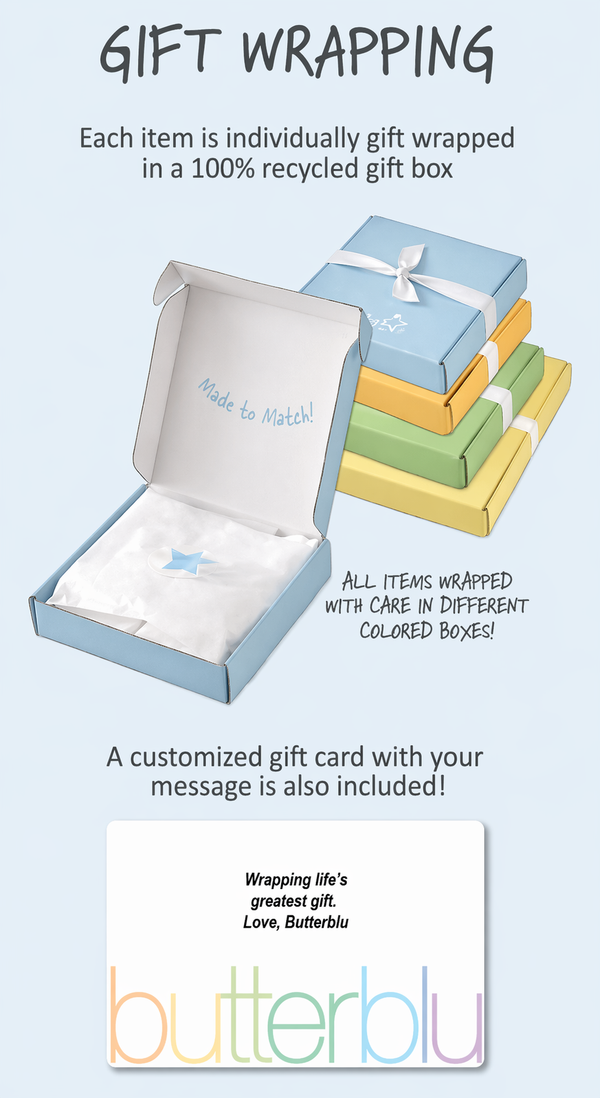
Butterblu’s entire clothing line is built for registries. Everything uses GOTS-certified organic cotton and is organized into the Made to Match™ color system — so gift-givers can buy complementary pieces without coordination stress, and you end up with a cohesive organic wardrobe.
- 5-pack bodysuits (short and long sleeve) — the most-gifted registry item
- Footed pajamas (Sleep & Play and snug-fit) — gifted constantly by grandparents
- Swaddle blankets — multi-use, endlessly practical
- Curated gift sets — pre-assembled for easy gifting at any budget (under $25 through $100)